Puppy Training in Chesapeake: Classes, Socialization and When to Start
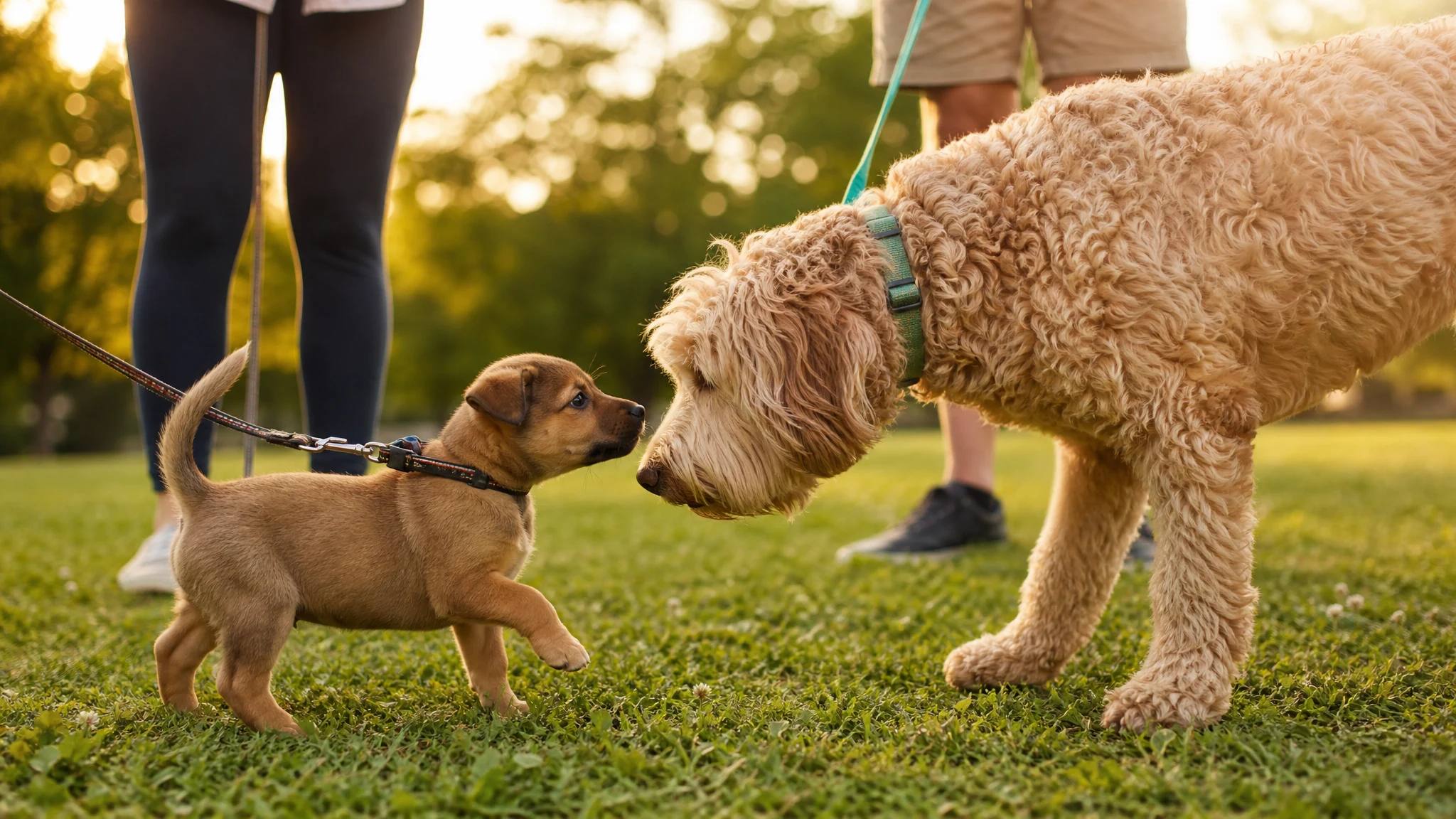
General training information. For aggression, sudden behavior changes or health concerns, see your veterinarian first.
A new puppy in Chesapeake comes with a lot of questions. When can we start? Is it safe to go out before the shots are done? What do the classes ask for?
This guide walks you through the first weeks, step by step. It covers puppy training classes, safe socialization around the city and the local rules that apply to a young dog. Where a fact depends on a clinic, store or agency, we point you to the source so you can confirm it.
When to Start Puppy Training
The short answer: the day your puppy comes home. Simple skills like name response, settling on a mat and taking treats gently can begin right away, in your own house and yard.
Classes are a separate question. The American Veterinary Society of Animal Behavior (AVSAB) has a position statement on puppy socialization. It says puppies can start socialization classes as early as 7 to 8 weeks of age, and that this can happen before the vaccine series is complete, as long as precautions are taken. The same position stresses that the early weeks are a sensitive window for learning about the world, and that the risk of behavior problems from poor socialization is a serious concern.
Those precautions matter. Ask your veterinarian what is right for your puppy, based on its age, health and vaccine history. Your vet knows the local disease picture and can tell you which situations to avoid.
What You Need Before You Begin
Materials
- Small, soft treats that your puppy loves, cut into pea-sized pieces
- A flat collar or a well-fitted harness, plus a standard leash
- A crate or a gated puppy area
- Chew toys and a few puzzle toys
- A treat pouch or a small container you can keep in your pocket
- Written proof of your puppy's vaccines from your veterinarian
- A log or notebook to track what your puppy has met and how it reacted
Paperwork
Keep your vaccine records in one place. Class providers ask for them, and you will need the rabies certificate for the city license too.
Step 1: Talk to Your Veterinarian First
Book a visit in the first few days. Ask these questions:
- Where is my puppy in its vaccine series, and when is each shot due?
- Which places and dogs are safe to meet right now?
- When should we start heartworm and tick prevention?
That last question matters in Hampton Roads. A WTKR News 3 report says the region is a heartworm hot spot, with vet clinics reporting about 100 cases per year. Another WTKR report quotes Old Dominion University tick researcher Holly Gaff, who describes Lone Star ticks as the most common locally, with blacklegged ticks also prominent in Virginia. Both reports are undated news stories, so ask your vet what prevention plan fits your puppy.
If your puppy ever seems ill, such as vomiting, diarrhea, lethargy or not eating, call your veterinarian promptly rather than waiting to see if it passes.
Step 2: Set Up the First Weeks at Home
Home is your first classroom. A calm routine does more for a young puppy than a busy schedule of outings.
- Pick a potty spot and a schedule. Take your puppy out after waking, after meals, after play and before bed. Reward right after it goes outside.
- Teach a name game. Say the name in a happy voice, and the moment your puppy looks at you, give a treat. Do a few repetitions at a time.
- Introduce the crate slowly. Toss treats inside, let your puppy walk in on its own, and build up short stays. Never use the crate as punishment.
- Handle gently. Touch paws, ears and mouth for a second, then give a treat. This makes grooming and vet visits easier later.
- Offer chew toys. Trade a toy for a treat when your puppy picks up something it should not have, instead of grabbing it away.
- Keep sessions short. Two to five minutes, several times a day, is plenty.
Step 3: Know the Chesapeake Rules for a Young Dog
Check these early so there are no surprises.
- Rabies vaccine. The City of Chesapeake Laws page (Sec. 10-43) says dogs and cats four months and older must be vaccinated against rabies by a licensed veterinarian. Virginia law (Va. Code 3.2-6521) also applies.
- License. The same page (Sec. 10-62) says dogs and cats four months and older must be licensed each calendar year. PetData, the city's licensing portal, lists 1-year fees of $10.00 for an unaltered dog and $7.00 for a spayed or neutered dog. All licenses expire December 31, and the rabies vaccination must be valid on the date you pay.
- Leash. Chesapeake City Code Sec. 10-42, as summarized on the city's Laws page, says dogs must be restrained by a collar or harness and a chain or leash when off the owner's or caretaker's property. Your puppy needs a leash for every outing, even short ones.
Fees and rules can change, so confirm current details with the City Treasurer or PetData before you pay.
Step 4: Find Puppy Training Classes in Chesapeake
Puppy training in Chesapeake is available through chain stores and independent trainers. For a wider look at options and costs, see our guide to dog training in Chesapeake, where to train and what it costs.
What puppy classes in Chesapeake may require
PetSmart has a Chesapeake store at Chesapeake Square, 4300 Portsmouth Blvd. The store page does not list vaccine rules, but PetSmart's chain-wide training page says:
- DPP with Adenovirus (a 1-year or 3-year vaccine) and rabies (1-year or 3-year, age appropriate) are required.
- Vaccines must be given at least 48 hours before a training session.
- Written proof is required before or at the start of the first class.
- Puppies can start as early as 10 weeks.
PetSmart's separate vaccination policy page lists rabies as required over 16 weeks and DPP as required over 3 months for training, and the two pages differ slightly. Call the Chesapeake store to confirm what applies to your puppy before you sign up.
Trainers with published credentials
Some independent trainers list credentials publicly. We cannot say whether they run puppy classes, so contact them to ask about class formats, vaccine requirements and schedules.
- Barks and Rec, Inc. Sarah Connor is listed as an IAABC Accredited Force-Free Dog Trainer (ADT) and a Licensed Family Paws Parent Educator. A directory profile gives 3065 Tyre Neck Rd., Chesapeake, VA 23321. The business website is barksandrecva.com.
- Freak On A Leash, LLC. Andrea Marx is listed in the CCPDT directory as CPDT-KA and CBCC-KA. The business's own site shows a Chesapeake location at 2536 Centerville Turnpike S, Chesapeake, VA 23322. Cheryl Shomo is also listed in the CCPDT directory (CPDT-KA, CBCC-KA, Fear Free Certified) and offers private in-home and virtual appointments. Her CCPDT profile gives a Virginia Beach address, so confirm her service area.
- Scott Casino. A DogTrainerLocator.com profile lists him as CPDT-KA in Chesapeake, VA. That directory is not the CCPDT's own, so verify the credential with the CCPDT.
This is not a ranking or a recommendation. It is a starting list of names that have public credentials.
What to look for in a class
- Reward-based methods only. AVSAB advises against punishment-based training, and a good class should not use shock, prong or choke collars, or physical corrections.
- Small groups with puppies of similar ages.
- Clear vaccine requirements and a clean, controlled space.
- Time for supervised play and for rest, not nonstop free-for-alls.
- Instructors who let a nervous puppy watch from a distance.
Watch a class first if you can. Ask what the trainer does if a puppy gets overwhelmed. A good answer is to give the puppy space and a break.
Step 5: Socialize Safely Around Chesapeake
Socialization means letting your puppy have calm, positive experiences with the things it will meet in life. It does not mean forcing contact or flooding a puppy with everything at once.
Good first outings
- Your own yard and driveway. Sit outside and let your puppy watch cars, bikes, neighbors and lawn equipment from a distance, with treats for calm looks.
- Carried or wagon outings. Ask your vet whether it is safe to carry your puppy to a quiet bench or sidewalk so it can watch the world without touching the ground.
- Visits with healthy, vaccinated adult dogs. Pick a calm dog whose owner confirms its vaccines, in a private yard.
- New people at home. Invite friends over, including someone with a hat, a person using a cane and a child who has been taught to be gentle.
- Car rides. Start with short trips that end somewhere fun, not just the vet.
Be careful with dog parks
Chesapeake has three fenced off-leash dog parks, listed on the official Visit Chesapeake tourism site. All require membership (day passes are available) and are open sunrise to sunset:
- Chesapeake City Park Dog Park, 900 City Park Drive. The front park has separate small-dog and large-dog areas, and the small-dog area is for dogs 25 lbs and under only.
- Chesapeake Dog Park, Deep Creek, 437 S. George Washington Highway.
- Chesapeake Dog Park, Western Branch, 4437 Portsmouth Boulevard.
The phone number listed for all three is (757) 382-6411. The listings link to guidelines flyers that cover the full rules, so read them and call before you go.
Dog parks put your puppy among dogs whose health and vaccine status you cannot check. Ask your veterinarian when your puppy is ready. Until then, parks are better used as places to watch from outside the fence, if your vet approves.
Watch your puppy's body language
Signs of a puppy who is comfortable include a loose body, a wiggly walk, taking treats and coming back to you. Signs of stress include a tucked tail, cowering, freezing, lip licking, turning away or refusing food.
If you see stress, move away, give space and try again later at a greater distance. Never push a puppy toward something it fears.
Step 6: Build Your Weekly Plan
- Daily: Three or four short training sessions at home, plus potty practice.
- Several times a week: One new, gentle experience, such as a new surface, sound or person. Log it.
- Weekly: A puppy class or a trainer visit once your vet says it is appropriate and the provider's vaccine rules are met.
- Every week: Review your log. Which experiences went well? What needs more distance or more treats?
Common Mistakes to Avoid
- Waiting until all shots are done to do anything. The AVSAB position is that early, careful socialization is important. Talk with your vet about a safe plan rather than keeping your puppy shut in.
- Doing too much too fast. A busy outing can overwhelm a young puppy. Short and positive beats long and loud.
- Letting everyone pet your puppy. You can say no. Let your puppy approach on its own terms.
- Using punishment. Scolding or physical corrections can make a puppy fearful. Redirect, reward what you like and manage the environment.
- Skipping the leash. Chesapeake's leash rule applies off your property, and a loose puppy can get into trouble quickly.
- Ignoring fear. If your puppy seems very afraid or reacts strongly to people or dogs, talk to your veterinarian. For any growling or biting toward people, see your veterinarian and a certified behavior professional.
What Results to Expect
Every puppy learns at its own pace. With steady practice, many puppies begin to respond to their names, settle in a crate and walk more calmly on a leash within a few weeks. Potty training often takes longer, and setbacks are normal.
Early positive experiences and a reward-based class may help your puppy feel more confident around new people, places and dogs. They may also make vet visits and grooming easier. Results vary with age, breed, temperament and how consistently you practice, and nothing here is a promise about how your puppy will turn out.
Helpful Local Contacts
- Chesapeake Animal Services Unit, 2100 S Military Highway, Chesapeake, VA 23322. The city lists the shelter on its website; confirm the phone number there before calling.
- Chesapeake Humane Society. Adoption Center at 1149 New Mill Drive, open Tuesday to Sunday, 12 pm to 4 pm, closed Monday. Phone 757-546-5355.
If you adopted your puppy from either, ask the staff what vaccines and checkups your puppy has already had. Bring those records to your first vet visit.
Sources
- City of Chesapeake, Laws page (Sec. 10-42, 10-43, 10-62)
- PetData, City of Chesapeake license fees
- PetSmart Services, training classes
- Visit Chesapeake, Chesapeake City Park Dog Park
- Visit Chesapeake, Deep Creek Dog Park
- Visit Chesapeake, Western Branch Dog Park
- Barks and Rec VA
- CCPDT Certified Dog Trainer Directory, Andrea Marx
- CCPDT Certified Dog Trainer Directory, Cheryl Shomo
- DogTrainerLocator.com, Scott Casino
- WTKR News 3, heartworm in Hampton Roads
- WTKR News 3, local tick research
- City of Chesapeake, Animal Services Unit
- Chesapeake Humane Society