Training Your Dog for Chesapeake's Weather and Terrain
General training information. For aggression, sudden behavior changes or health concerns, see your veterinarian first.
Chesapeake dogs deal with warm, humid stretches, mosquitoes, ticks and a mix of sidewalks, lawns, trails and fenced dog parks. A few simple skills make all of it safer. Your dog learns to leave things alone, come when called, let you handle their paws, and settle down to cool off.
This guide covers walking a dog in heat, hot pavement dogs may struggle with, and the pest risks that matter for Chesapeake dog safety. Everything here uses treats, praise and patience. Nothing here needs force or harsh tools.
What Is Documented Locally, and What Is Not
Two hazards have local reporting behind them. A WTKR News 3 report says Hampton Roads is a heartworm hot spot, with local vet clinics reporting about 100 cases a year. A separate WTKR report quotes Old Dominion University tick researcher Holly Gaff, who describes Lone Star ticks as the most common locally, with blacklegged ticks also prominent in Virginia. Both reports are undated news stories, so ask your veterinarian what is current.
We did not find a Chesapeake agency page on summer heat, pavement temperatures or winter road salt. So we do not give local numbers for those. Ask your veterinarian, and check with the City of Chesapeake for anything about specific trails or parks. The training steps below still help with heat and pavement, because they work on your dog's habits rather than on a number.
Materials You Will Need
- A flat collar or a harness, plus a standard leash. Chesapeake City Code Sec. 10-42, as summarized on the city's Laws page, requires dogs off the owner's property to be restrained by a collar or harness and a chain or leash.
- Small, soft treats your dog loves, cut pea-size.
- A treat pouch and a long line (a lightweight leash of 15 to 30 feet) for recall practice outside a fence.
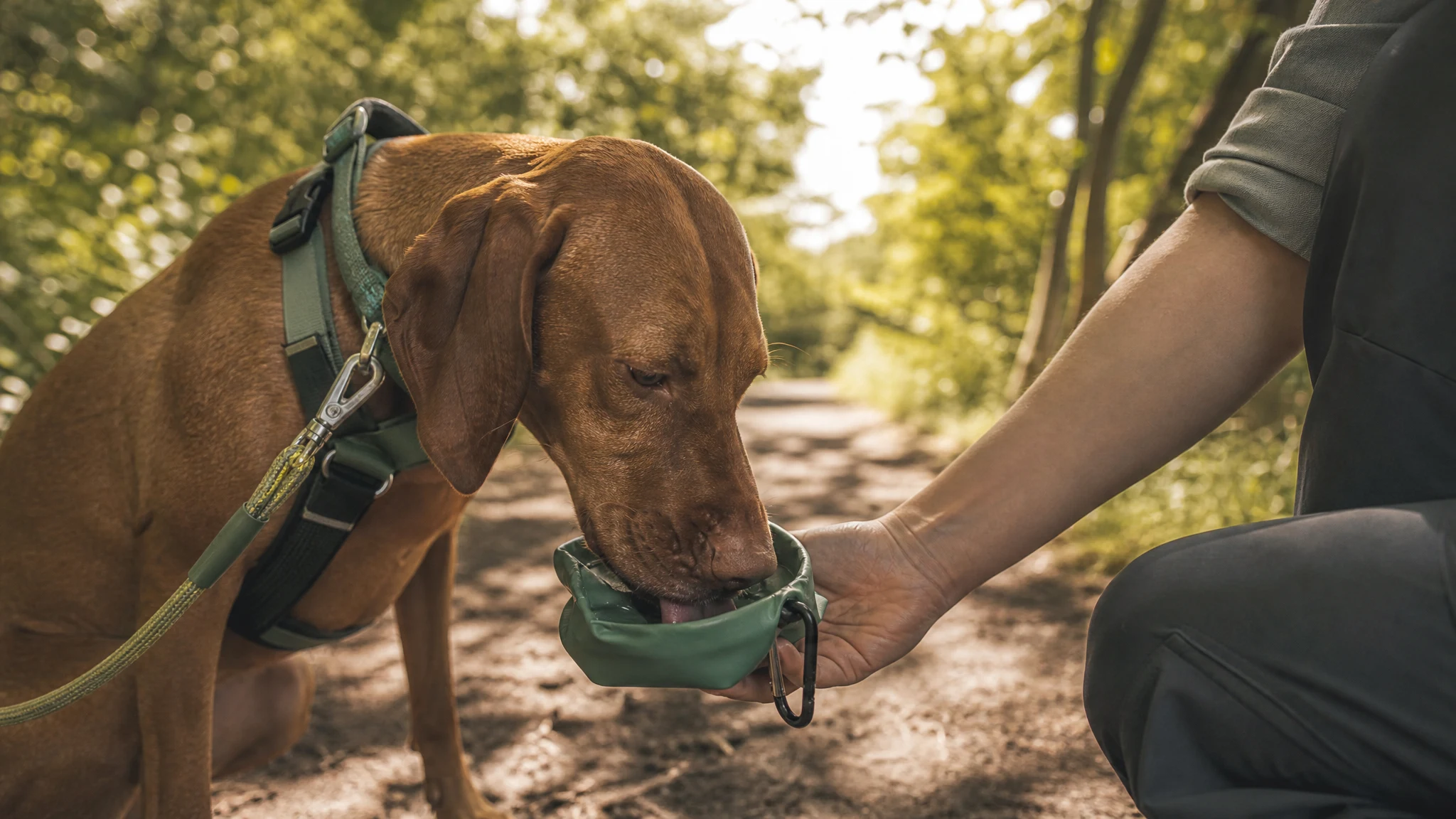
- A collapsible water bowl and fresh water for every outing.
- A towel and a tick-check routine (your fingers and good light are enough).
- Optional: dog booties, if your veterinarian agrees they suit your dog.
- Your veterinarian's advice on year-round heartworm and tick prevention.
Step 1: Build a Reliable "Leave It"
"Leave it" helps with dropped food, dead animals, litter and anything else you would rather your dog skip on a trail or sidewalk.
- Hold a treat in a closed fist. Let your dog sniff and lick without opening your hand.
- The moment your dog pulls away, even for a second, say "yes" and give a different treat from your other hand.
- Repeat until your dog backs off as soon as you close your fist.
- Add the cue "leave it" just before you present the fist.
- Move up to a treat on the floor under your shoe, then a treat on the floor uncovered, then on walks with ordinary distractions.
Common mistake: repeating the cue over and over. Say it once, wait, and reward the choice to look at you.
Step 2: Teach a Strong Recall
A dog who comes when called can be pulled out of the way of a hot surface, a wild animal or a tick-heavy patch of brush. Recall also matters legally. The city's Laws page describes Sec. 10-42 as requiring restraint off your property, and Virginia law (Va. Code 3.2-6538) lets localities prohibit dogs running at large. Keep your dog on leash or in a fenced dog park.
- Choose a happy word, such as "here," and use it only for good things.
- Indoors, say the word in a cheerful voice, step back and reward your dog for reaching you with a few treats in a row.
- Practice in the yard, then on a long line in a quiet open space.
- Add distance a few feet at a time. Reward generously every time.
- Never call your dog to scold them. A dog who is punished for arriving learns not to arrive.
Step 3: Practice Paw Handling
Handled paws are easier to check after a walk for irritation, burns, or ticks hiding between the toes. They also make it easier to fit booties if your veterinarian suggests them.
- Touch one shoulder, say "yes," and give a treat.
- Slide your hand down the leg a little at a time, rewarding each step.
- Touch a paw for one second, reward, and release.
- Build to holding a paw for a few seconds, gently spreading the toes and looking between them.
- Keep sessions to a minute or two. Stop while your dog is still relaxed.
If your dog flinches or pulls away from a particular paw, tell your veterinarian. Pain can look like a training problem.
Step 4: Walking a Dog in Heat, and Dealing with Hot Pavement
Hot pavement dogs feel through bare paws can cause burns, and dogs cool themselves mostly by panting, which works less well in humid air. We do not have a Chesapeake source for specific temperatures, so rely on your own observation and your veterinarian's guidance.
- Test the surface. Press the back of your hand on the pavement for several seconds. If it is uncomfortable for you, it is not right for your dog's paws.
- Change when and where you walk. Choose early morning or evening, and favor grass and shade over asphalt. Dog parks here are open sunrise to sunset, so the early part of the day is an option, according to the Visit Chesapeake listings.
- Teach a "let's go" onto grass. Say "let's go," step onto the grass, and reward your dog for following. Use it any time the surface looks or feels too warm.
- Practice a cooling routine. At the end of each outing, cue "settle" on a mat in the shade or indoors. Offer water and reward calm behavior. Dogs who learn to rest on cue tend to cool down faster than dogs who stay wound up.
- Learn the signs of trouble. Heavy panting that does not ease, drooling, wobbling, vomiting or collapse need a veterinarian right away. Do not wait to see if it passes.
Booties acclimation, if your veterinarian approves: Put a bootie on one paw for a second, reward, and remove it. Build to all four paws indoors, then to short walks. Many dogs high-step at first, so go slowly and stop if your dog seems upset. Booties are not a substitute for avoiding hot surfaces.
Step 5: Make a Post-Walk Tick Check a Habit
Per the WTKR reporting that quotes Old Dominion University's Holly Gaff, Lone Star ticks are common locally and blacklegged ticks are also present in Virginia. Brush, tall grass and wooded edges are the places to be careful.
- Stay on the middle of trails when you can, and keep your dog out of tall brush using "leave it" and "let's go."
- After each walk, run your hands over your dog while giving treats: ears, armpits, between the toes, under the collar, around the tail.
- Use the paw handling from Step 3 to check between the toes.
- If you find a tick, ask your veterinarian how to remove it and what to watch for afterward.
Ask your veterinarian about tick prevention that fits your dog. Training reduces exposure but does not replace it.
Step 6: Respect Mosquito Season and Heartworm
Heartworm spreads through mosquito bites, and WTKR reports that Hampton Roads is a hot spot. You cannot train a dog to avoid mosquitoes, but you can adjust your routine.
- Ask your veterinarian about heartworm testing and prevention. Do not start or stop medication on your own.
- Teach a cooperative "stand" or "settle" so that medicine time, whether chewables or applications, is calm and rewarding.
- Take extra care around standing water and at dusk, when you may notice more mosquitoes.
Step 7: Practice at Chesapeake Dog Parks the Smart Way
Fenced parks are a useful place to practice recall and cooling routines. According to Visit Chesapeake's listings, the city's dog parks require a membership (day passes are available) and are open sunrise to sunset:
- Chesapeake City Park Dog Park, 900 City Park Drive. The small dog area is for dogs 25 pounds and under.
- Chesapeake Dog Park at Deep Creek, 437 S. George Washington Highway. The listing says the drinking fountain is turned off in winter, so bring your own water.
- Chesapeake Dog Park at Western Branch, 4437 Portsmouth Boulevard.
For rules and membership, call (757) 382-6411. Practice your "come" and "settle" cues there in short rounds, with water breaks in the shade. For more on training locations and costs, see our guide to dog training in Chesapeake, including where to train and what it costs.
Cold, Salt and Wildlife
We did not find Chesapeake-specific documentation on winter road salt or on local wildlife hazards. If you notice irritation after winter walks, rinse and dry your dog's paws and ask your veterinarian. Because paw handling is already practiced, this goes more smoothly. Keep your dog leashed and use "leave it" and your recall around any wild animals. For wildlife concerns on city land, check with the City of Chesapeake.
Tips for Success
- Keep sessions short, two to five minutes, a few times a day.
- Practice each skill in an easy place before using it in a harder one.
- Pay well. Treats cost less than a vet visit.
- Carry water and plan shade before you leave home.
- Keep your dog's license and rabies vaccination current. Chesapeake requires dogs four months and older to be vaccinated against rabies by a licensed veterinarian (Sec. 10-43) and licensed each calendar year (Sec. 10-62). PetData, the city's licensing portal, lists 1-year fees of $10.00 for an unaltered dog and $7.00 for a spayed or neutered dog. All licenses expire December 31.
Common Mistakes to Avoid
- Walking at midday because it fits your schedule, then relying on the dog to tell you it is too hot.
- Assuming a dog who still wants to play is not overheating. Many dogs keep going past the point of comfort.
- Calling your dog and then ending the fun. Sometimes call, treat and release them back to play.
- Using punishment or harsh tools. The American Veterinary Society of Animal Behavior (AVSAB) supports reward-based training, and shock, prong and choke collars or dominance methods add fear and risk.
- Skipping the tick check because your dog is on prevention.
What Results to Expect
With regular practice, many dogs get better at leaving distractions alone, coming when called and settling after exercise. Paw handling often gets easier within a couple of weeks, though every dog moves at their own pace. These skills may make hot-weather outings and post-walk checks smoother, but they do not remove the risk, and no routine can guarantee safety.
If your dog shows signs of heat distress, pain, or a sudden change in behavior, call a veterinarian. If your dog is aggressive toward people, see a veterinarian first, then work with a certified behavior professional.
Sources
- City of Chesapeake, Laws page (Sec. 10-42, 10-43, 10-62)
- Code of Virginia, 3.2-6538
- PetData, City of Chesapeake license fees
- Visit Chesapeake: Chesapeake City Park Dog Park
- Visit Chesapeake: Dog Park, Deep Creek
- Visit Chesapeake: Dog Park, Western Branch
- WTKR News 3: Hampton Roads is a heartworm hot spot
- WTKR News 3: Local researchers tracking tick troubles