Off-Leash Dog Parks in Chesapeake and How to Train for Them
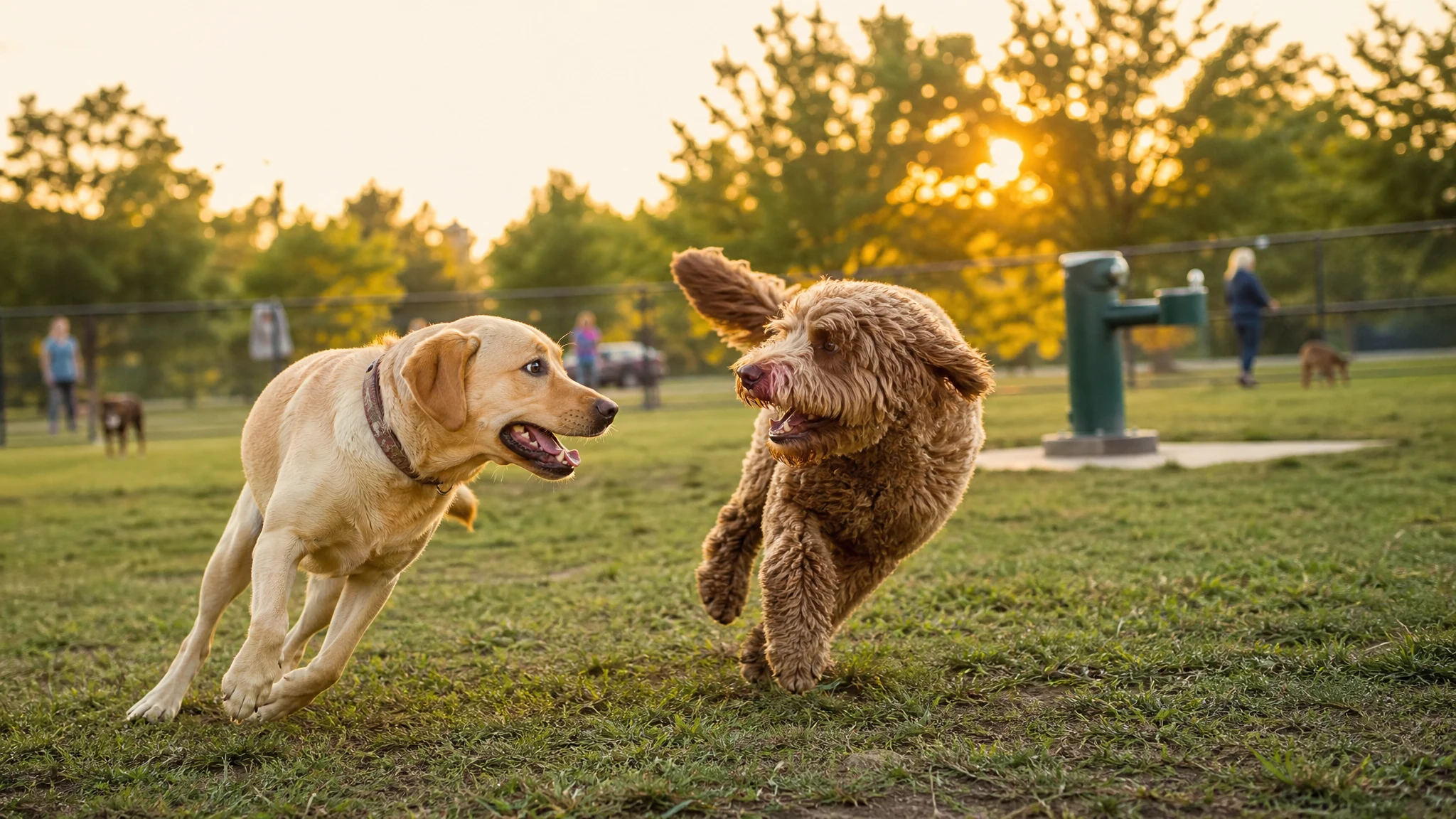
General training information. For aggression, sudden behavior changes or health concerns, see your veterinarian first.
A fenced field where your dog can run sounds like the easy part of dog ownership. For many dogs it is. For others, the first visit is loud, crowded and confusing, and it teaches the wrong lessons.
This guide covers the dog parks Chesapeake offers, what the city's tourism listings say about each one, and a step-by-step plan to get your dog ready. It also covers the signs that a dog park is not the right fit for your dog, which is just as important.
Dog Parks in Chesapeake: What the Listings Say
Chesapeake has three fenced, off-leash parks listed by Visit Chesapeake, the city's official tourism site. All three require a membership, and day passes are available. All three are open daily from sunrise to sunset, and all three share the phone number (757) 382-6411.
Each listing links to a full guidelines and membership flyer. Read that flyer before your first visit, because it holds the complete rules. Use the details below as a starting point, not a replacement.
Chesapeake City Park Dog Park
- Address: 900 City Park Drive, Chesapeake, VA 23320
- Layout: The front park has separate small-dog and large-dog areas. Visit Chesapeake says the small dog area is for dogs 25 pounds and under only. The rear park has 6-foot fencing with separate small and medium-large areas.
Chesapeake Dog Park, Deep Creek
- Address: 437 S. George Washington Highway, Chesapeake, VA 23323
- Layout: One large fenced off-leash area for all dogs. Visit Chesapeake notes the drinking fountain is turned off in winter, so bring your own water in cold months.
Chesapeake Dog Park, Western Branch
- Address: 4437 Portsmouth Boulevard, Chesapeake, VA 23321
- Layout: Fenced and off-leash. The listing offers single-day passes and does not spell out specific rules, so call or read the guidelines flyer for details such as size divisions.
If you are hunting for an off leash dog park near Chesapeake's Deep Creek area, or closer to Western Branch or City Park, these three are the ones in the city listings. For anything beyond them, such as hours changes or membership costs, call the number above or check the city's pages before you go.
City Rules That Apply Before You Ever Reach the Gate
A fenced park is the one place your dog is allowed off leash. Everywhere else, city law applies.
- Leash: The City of Chesapeake's Laws page (Sec. 10-42) says dogs and cats must be restrained by a collar or harness and a chain or leash when off the owner's or caretaker's property. That includes the walk from your car to the park gate.
- Rabies vaccine: The city's Laws page (Sec. 10-43) and Va. Code 3.2-6521 require dogs four months and older to be vaccinated against rabies by a licensed veterinarian.
- License: Dogs four months and older must be licensed each calendar year (Sec. 10-62). PetData, the city's licensing portal, lists a 1-year fee of $10.00 for an unaltered dog and $7.00 for a spayed or neutered dog. Licenses expire December 31, and the rabies vaccine must be valid on the date of payment.
Park-specific vaccine or tag requirements are not listed in the summaries above, so ask when you call about membership.
Materials You Will Need
- A flat collar or a well-fitted harness, plus a standard leash (a 4 to 6 foot leash is easy to handle)
- A long line of about 15 to 30 feet for practicing recall in open spaces
- Small, soft treats your dog loves, in a pouch you can reach quickly
- A higher-value reward for recall, such as tiny pieces of cooked chicken
- A water bottle and collapsible bowl
- Proof of rabies vaccination and your dog's license, plus your membership or day pass
- A few weeks of short, regular practice time
Reward-based training is the approach used here, in line with the American Veterinary Society of Animal Behavior (AVSAB). Avoid shock, prong or choke collars, and skip any dominance-based methods. They add fear and stress, which is the opposite of what you want around other dogs.
Step-by-Step: Training Your Dog for Off-Leash Parks
Step 1: Build a reliable recall in easy places
Recall is the skill that matters most. If your dog will not come when called at home, the park is not the place to find that out.
- Pick one cheerful word, such as "here," and use it only for coming to you. Never use it before something your dog dislikes, like a bath.
- Start indoors. Say the word once in a happy voice, and reward the moment your dog arrives.
- Move to the yard, then to a quiet area on a long line. Gradually add distance.
- Always reward. Even if your dog was slow, a treat and praise keep coming to you worth the effort.
- Add distractions slowly: a toy on the ground, a person walking by, then a calm dog at a distance.
Common mistake: repeating the cue over and over. Say it once, then make yourself interesting by crouching, backing away or clapping. If your dog is not responding, you have moved too fast. Go back to an easier setting.
Step 2: Teach check-ins
A check-in means your dog looks at you or returns to your side on their own, without being called. It keeps your dog connected to you in a busy space.
- On a walk, wait quietly. The moment your dog glances at you, say "yes" and give a treat.
- Repeat until your dog starts offering eye contact often.
- Practice in the yard off a long line, then on a leash outside the park fence.
- Reward every voluntary check-in, especially when something exciting is nearby.
Tip: Practice at the park entrance, before you go in. A dog who can check in while watching a play yard from outside has a much better chance of staying thoughtful once inside.
Step 3: Practice leaving things and calm greetings
Dog parks involve toys, treats dropped by other people, and dogs rushing the gate. Teach "leave it" and a calm sit at doors and gates.
- Hold a treat in a closed fist. Wait for your dog to stop nosing at it, then reward from the other hand.
- Progress to a treat on the floor under your hand, then uncovered.
- Practice sitting politely before every door, gate and car exit. The door opens only when your dog is calm.
Common mistake: letting your dog pull you through the gate. Entering in a frenzy sets the mood for the whole visit.
Step 4: Learn to read dog play
You are your dog's advocate. Knowing healthy play from trouble lets you step in early.
Signs of good play include:
- Loose, bouncy, wiggly bodies
- Play bows and exaggerated movements
- Taking turns chasing and being chased
- Short breaks, then returning to play
Signs to interrupt include:
- A stiff body, hard stare or raised hackles
- One dog constantly hiding, tucking the tail or trying to leave
- Several dogs chasing one dog
- Mounting, pinning or growling that is not easing off
When in doubt, call your dog away calmly, reward the recall, and give everyone a break. Your dog should feel the park is a place where good things happen, not one where you only call them when they are in trouble.
Step 5: Practice leaving calmly
Leaving is a skill too. Many dogs learn that the end of the park visit is the end of fun, so they run from you.
- Call your dog during the visit several times, reward, and then release them back to play. This teaches that coming to you does not always mean leaving.
- When it is time to go, leave while your dog is still doing well, not after they are worn out or overexcited.
- Clip the leash on, give a treat, and walk out together calmly.
Step 6: Do a short first visit
Arrive at a quiet time, if you can. Stay at the fence for a few minutes and let your dog watch. Enter, stay five to ten minutes, and leave on a high note. Build duration over the following visits.
If your dog is under 25 pounds and you are using the City Park location, check which area they belong in. The listing says the small dog area is for dogs 25 pounds and under.
Tips and Common Mistakes
- Do not use the park to "socialize" a fearful dog. Crowds can make fear worse. Gentle, controlled exposure is a better approach.
- Stay off your phone. Your attention is the main safety tool. Be close enough to step in.
- Skip treats and toys inside unless the rules allow them. Food and toys can cause fights. Check the guidelines flyer first.
- Watch your timing. A tired, overexcited dog is more likely to make poor choices. Short and happy beats long and chaotic.
- Do not punish a slow recall. Scolding teaches your dog that coming to you is unpleasant.
- Ask a professional for help if you are stuck. Our guide to dog training in Chesapeake explains where to find classes and what to look for.
Health Notes for Chesapeake Dogs
Outdoor play brings outdoor risks. A WTKR News 3 report describes Hampton Roads as a heartworm hot spot, with local vet clinics reporting about 100 cases a year. The report is undated, so ask your veterinarian what prevention is right for your dog.
WTKR also quoted Old Dominion University tick researcher Holly Gaff, who described Lone Star ticks as most common locally, with blacklegged ticks also prominent in Virginia. After park or trail time, run your hands over your dog and check around the ears, armpits and between the toes. Your veterinarian can advise on tick control.
When a Dog Park Is Not Right for Your Dog
Not every dog enjoys a dog park, and that is perfectly fine. A park may not be a good fit if your dog:
- Is under four months old, or has not finished their vaccinations
- Is afraid of other dogs, or tries to hide or flee
- Guards toys, food, you or the gate
- Does not come when called at all in the yard
- Plays so roughly that other dogs avoid them
- Is recovering from illness or surgery
- Is an unspayed female in heat or an unaltered male who is repeatedly targeted
If your dog has growled, snapped or bitten a person or another dog, skip the dog park for now. Talk to your veterinarian first, to rule out pain or illness, and then work with a certified behavior professional. Under Chesapeake Sec. 10-47.1, dogs that attack other animals or people may be impounded until a court hearing, so prevention matters.
You still have good options. Leashed walks, sniff-focused strolls, backyard games, a long line in a safe open space, and calm meet-ups with one known dog can all give your dog exercise and enrichment without the pressure of a shared yard.
What Results to Expect
With short, regular practice, many dogs show better recall and more focus on their owners within a few weeks. Progress depends on your dog's age, history, temperament and the distractions around them, so results vary. Some dogs take months to become reliable around other dogs, and some may always do best in quieter settings.
Measure success by small wins: a faster turnaround at the gate, a check-in during play, a calm exit. Those moments add up.
Sources
- City of Chesapeake, Laws page
- Visit Chesapeake: Chesapeake City Park Dog Park
- Visit Chesapeake: Chesapeake Dog Park, Deep Creek
- Visit Chesapeake: Chesapeake Dog Park, Western Branch
- PetData: City of Chesapeake license fees
- Code of Virginia, 3.2-6521
- WTKR News 3: Hampton Roads heartworm report
- WTKR News 3: Local tick researchers report