Help for a Reactive or Aggressive Dog in Chesapeake
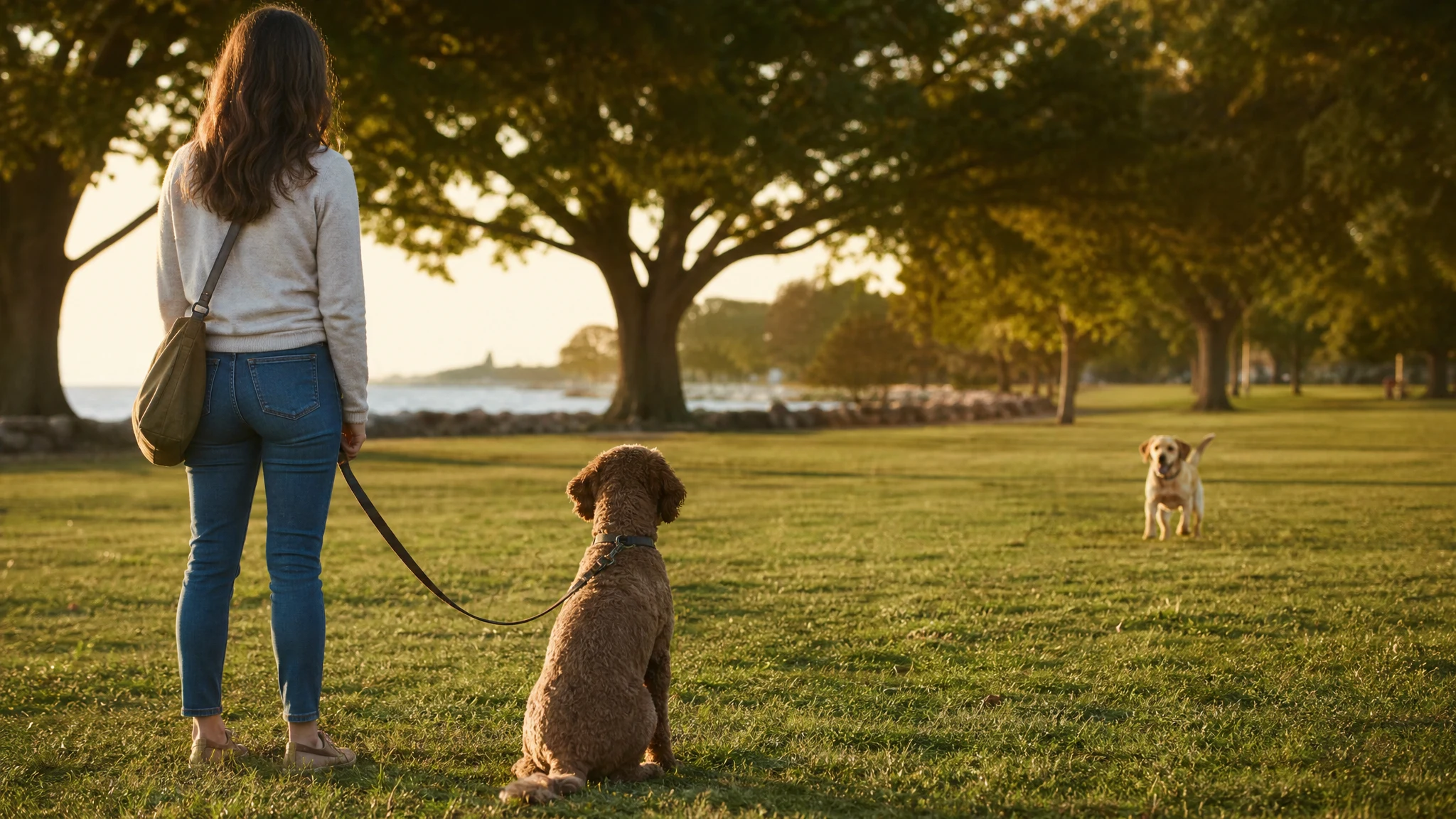
General training information. For aggression, sudden behavior changes or health concerns, see your veterinarian first.
Lunging, barking, growling or freezing on a walk is scary and embarrassing. It is also common, and many dogs can improve with patient, humane work. This guide covers reactive dog training basics for Chesapeake owners: how to stay safe, what to do on walks, when to call a veterinarian, and what the city says about dogs that bite or attack.
It is general education, not a diagnosis. If your dog has hurt someone or you are afraid of what could happen, skip ahead to the safety and professional help sections first.
What reactivity and aggression mean
A reactive dog overreacts to a trigger. Common triggers are other dogs, strangers, bikes, skateboards or car doors. The reaction can look like barking, lunging, growling or spinning on the leash. Underneath, it is usually fear, frustration or overexcitement.
Aggression is behavior meant to create distance or cause harm, such as snarling, snapping or biting. Many reactive dogs are not aggressive, but a reactive dog that is pushed too close can bite. Treat both with respect.
Whatever your dog is doing, it is communicating. The goal is not to silence the warning. The goal is to change how your dog feels about the trigger, so the warning is no longer needed.
Safety comes first
Before any training, make your daily life safer. Safe dogs and safe people make learning possible.
- Keep your dog on a secure leash, with a collar or harness, whenever you are off your own property. Chesapeake City Code Sec. 10-42, as summarized on the City of Chesapeake Laws page, requires dogs to be restrained by a collar or harness and a chain or leash off the owner's or caretaker's property.
- Use a well-fitted, comfortable harness or flat collar. Avoid anything designed to cause pain (see the section on punishment below).
- Use baby gates, closed doors or a crate to keep guests and your dog apart until you have a plan.
- Do not leave children alone with a dog that has shown aggression.
- Do not take a reactive dog to a busy dog park to "socialize." Chesapeake's city dog parks are fenced and off-leash, which is the opposite of a controlled setting.
If your dog may bite, ask a professional about conditioning your dog to a basket-style muzzle. Done slowly with treats, many dogs accept one comfortably.
What you need
- A flat collar or well-fitted front-clip or back-clip harness, plus a standard 4 to 6 foot leash (avoid retractable leashes).
- Small, soft, high-value treats your dog loves, such as tiny pieces of cooked chicken or cheese, in a treat pouch.
- A calm, low-traffic place to practice, with room to move away from triggers.
- A notebook or phone notes to record triggers, distances and your dog's body language.
- Patience, and a plan to pause and call a professional if things get worse.
Step-by-step: a humane plan for a reactive dog
The method below is built on desensitization and counter-conditioning. Desensitization means gradual exposure to a trigger at a level your dog can handle. Counter-conditioning means pairing that trigger with something wonderful, so the dog's feelings about it change over time.
Step 1: Rule out pain and illness
Book a veterinary exam first. Pain, thyroid problems, ear or skin trouble, and other medical issues can make a dog touchy or reactive. Tell the veterinarian exactly what you see, when it happens and how often. Video clips help.
Step 2: Learn your dog's body language
Watch for early signs of stress before the barking starts: stiff posture, hard stare, closed mouth, whale eye (showing the whites), lip licking, yawning, turning away or pulling hard toward or away from something. Catching these early lets you act before your dog is over the edge.
Step 3: Find your dog's threshold distance
The threshold is the distance at which your dog notices the trigger but can still take a treat and think. If your dog is barking or lunging, you are too close. Back up until your dog is relaxed enough to eat. For some dogs this is 100 feet or more at first, and that is fine.
Step 4: Pair the trigger with treats
Each time your dog sees the trigger at a comfortable distance, calmly feed a steady stream of treats. When the trigger goes away, the treats stop. Over many repetitions, the trigger starts to predict good things. Keep sessions short, often just a few minutes.
Step 5: Teach an easy "look at me" and a U-turn
Practice at home first. Say your dog's name, and reward when they look at you. Then practice a cheerful U-turn: say "let's go," turn, and walk away while feeding treats. This gives you a calm exit when a trigger appears sooner than expected.
Step 6: Close the distance very slowly
Only when your dog stays relaxed and looks to you for treats should you move a little closer, perhaps a few steps at a time over several sessions. If your dog tenses, barks or stops eating, you went too fast. Go back to the last distance that worked.
Step 7: Manage the rest of the day
Every outburst rehearses the behavior. Walk at quieter times, cross the street early, use parked cars as visual barriers, and consider enrichment such as sniffing games, food puzzles and chews at home. A tired, well-fed, calm dog learns better.
Step 8: Track progress and be consistent
Write down distances and reactions. Progress is rarely a straight line. Everyone in the household should use the same plan and the same cues.
Why punishment makes it worse
It is tempting to correct a dog that lunges or growls. Please don't. The American Veterinary Society of Animal Behavior (AVSAB) advises that punishment-based methods can increase fear, anxiety and aggression, and that reward-based training is the recommended approach for behavior problems.
Here is why that makes sense. If your dog barks at another dog because they are scared, and the leash jerks or they get shocked, they learn that other dogs predict pain. The fear grows. A dog may also stop growling, because growling got punished, and then bite with little warning.
For that reason, stay away from shock, prong and choke collars, alpha rolls, scruffing and any "dominance" advice. A trainer who recommends them is not following the humane approach described here.
Tips and common mistakes
- Going too close, too soon. This is the most common mistake. More distance usually means more learning.
- Using boring treats. Triggers are hard. Use the best food you have.
- Flooding. Forcing a scared dog to "face it" tends to backfire.
- Letting strangers greet. Ask people to give your dog space. A simple "we're training, thank you" is enough.
- Skipping the vet. Untreated pain can undo good training.
- Training when you are stressed. Dogs read tension through the leash. Breathe, slow down, and end a session early if needed.
- Expecting a quick fix. Change usually takes weeks to months of steady practice.
When to see a veterinarian or veterinary behaviorist
Call your veterinarian promptly if the behavior is sudden, getting worse, or comes with changes in appetite, sleep, mobility or housetraining. In older dogs, a sudden change in temperament deserves a medical check.
If your dog has bitten or tried to bite a person, or you cannot predict or safely manage the reactions, you need both a veterinarian and a certified behavior professional. A veterinarian can discuss whether a referral to a board-certified veterinary behaviorist makes sense. Veterinary behaviorists can diagnose underlying conditions and, when appropriate, discuss medication alongside a training plan. I do not have a Chesapeake behaviorist to list here, so ask your veterinarian for a referral.
If the situation is an emergency, such as a serious injury to a person or another animal, get medical help for the injured person or animal right away and contact your veterinarian.
Trainers with certifications in Chesapeake
Working with a qualified, force-free professional often speeds things up and keeps everyone safer. The following people appear in public certification or trainer directories. This is not a ranking or recommendation, and you should confirm credentials, service area, methods and experience with reactive and aggressive dogs before hiring anyone.
- Andrea Marx, Freak On A Leash, LLC. The Certification Council for Professional Dog Trainers (CCPDT) directory lists CPDT-KA and CBCC-KA credentials. The business's own site shows a Chesapeake location at 2536 Centerville Turnpike S. Her CCPDT profile gives a Virginia Beach address.
- Cheryl Shomo, Freak On A Leash. The CCPDT directory lists CPDT-KA, CBCC-KA and Fear Free Certified. The profile gives a Virginia Beach address and mentions in-home and virtual appointments. Ask whether Chesapeake is within the service area.
- Sarah Connor, Barks and Rec, Inc. Her own website describes her as an IAABC Accredited Force-Free Dog Trainer (ADT) and a licensed Family Paws Parent Educator. A trainer directory lists a Tyre Neck Rd. address in Chesapeake, so confirm location details with her directly.
- Scott Casino. A DogTrainerLocator profile lists CPDT-KA and a Chesapeake, VA location. That site is a directory of CPDT-KA holders and is not the CCPDT's own directory, so verify the credential with the CCPDT.
For a broader look at classes, group settings and what training typically involves in the city, see our guide to dog training in Chesapeake, where to train and what it costs. I do not have published prices for these trainers, so ask each one directly.
Good questions to ask: What methods do you use? Do you use any tools that cause pain or fear? How do you handle a dog that may bite? What does a typical plan look like?
Chesapeake rules to know
A few local rules matter for owners of reactive or aggressive dogs.
- Leash rule. As noted above, Sec. 10-42 requires restraint by a collar or harness and a leash or chain off your property, according to the City of Chesapeake Laws page.
- License and rabies. The city requires dogs four months and older to be vaccinated against rabies by a licensed veterinarian (Sec. 10-43) and licensed each calendar year (Sec. 10-62). Current vaccination records also matter if your dog is ever involved in a bite incident.
- Dangerous dog rule. Under Chesapeake Sec. 10-47.1, a dog that attacks other animals or humans may be impounded until a court hearing. A dog found vicious or dangerous may be destroyed, removed or otherwise confined. Under Virginia Code 3.2-6540, an officer seeks a summons, the general district court holds a hearing, and the Commonwealth must prove its case beyond a reasonable doubt.
The takeaway is simple: preventing a bite is far better than dealing with a hearing. If your dog has bitten or attacked, contact Chesapeake Animal Services through the City of Chesapeake website and consider speaking with an attorney about your situation. Check the city's pages for current details.
Local spaces that may or may not suit your dog
Chesapeake's fenced dog parks (City Park, Deep Creek and Western Branch) require a membership or day pass, and they are open daily from sunrise to sunset, according to Visit Chesapeake. Off-leash areas are usually a poor fit for a reactive or aggressive dog, because you cannot control who approaches. Call (757) 382-6411 for the current guidelines if you want to know whether quieter hours or a small-dog section could work for a dog with a clear plan from a professional. Many owners do better with quiet streets, empty parking lots at off hours, and private fenced yards.
What results to expect
Every dog is different. With consistent, reward-based work, many owners see their dogs recover faster after triggers, notice them at shorter distances without exploding, and take treats at distances that used to be too close. Some dogs improve a lot over weeks or months. Others improve slowly and always need management, such as extra distance or a muzzle in certain situations.
Results depend on your dog's history, health, age and genetics, and on how consistently the plan is used. No method can promise a particular outcome, so aim for steady progress rather than a perfect dog.
Final thoughts
A reactive or aggressive dog is not a bad dog. Start with safety and a veterinary visit, use distance and treats to change how your dog feels, and bring in a qualified, humane professional if you are unsure. Small, calm wins add up.
Sources
- City of Chesapeake, Laws page (Sec. 10-42, 10-43, 10-47.1, 10-62)
- Code of Virginia, Va. Code 3.2-6540
- City of Chesapeake, Animal Services Unit
- Visit Chesapeake, Chesapeake City Park Dog Park
- CCPDT Certified Dog Trainer Directory, Andrea Marx
- CCPDT Certified Dog Trainer Directory, Cheryl Shomo
- Barks and Rec VA
- DogTrainerLocator.com, Scott Casino